Public Discourse
Indicator
The Public Discourse Indicator shows the accumulated comment data of the biggest news portals in Switzerland.
Weekly submitted posts
Roughly 70,000 to 135,000 posts are submitted to media platforms for publication each week. This includes posts that are never published. In particularly news-heavy weeks, such as the end of February 2025, when the German election took place and President Zelensky met President Trump at the White House, there is also an increase in online discourse.
Proportion of posts toxic hate speech
Last week, between 11.2 and 18.0 percent of the submitted posts were toxic and between 1.0 and 4.2 percent included hate speech. The majority of these are never published. For more information on how we define toxicity and hate speech, see our FAQs.
How many authors write hateful posts?
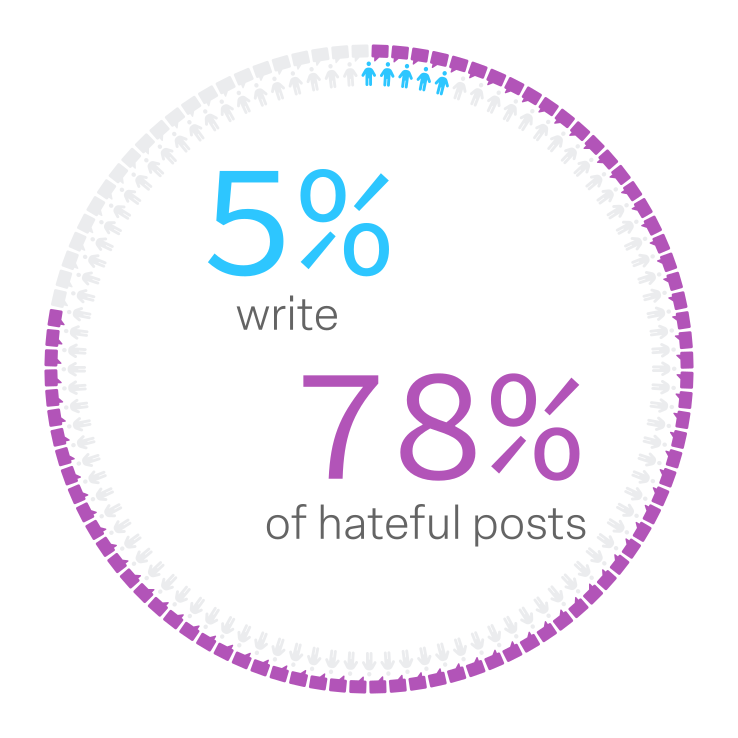
Not all users write hate speech. On the contrary: a small number of users is responsible for the vast majority of hate speech - just 5 percent of users write 78 percent of submitted hate comments.
FAQs
What is hate speech and what are toxic posts (definition)?
We consider contributions to be toxic when they fall into at least one of the following categories: threats (e.g., “I’ll kill you”), insults (e.g., “You idiot”), defamation (e.g., “Liar”), vulgar language (e.g., “Shit”), degrading or demeaning language (e.g., “Even a five-year-old would understand that”), malicious intent (e.g., “You should kill yourself”), or exclusionary language (e.g., “Shut up”).
We define hate speech as posts that are toxic (see above) and that target an individual or a social group based on their identity characteristics — that is, their religion, ethnic affiliation or origin, ancestry (including migration status), skin color, nationality, gender, sexual orientation, or a severe disability.
How do we identify hate speech and toxic posts?
We have developed our own algorithm based on artificial intelligence to identify hate speech and toxicity.
In detail, trained experts annotated thousands of highly similar posts as toxic or hate speech (or neither) and the algorithm learned based on these annotations to differentiate between toxicity, hate speech, and normal posts. New posts are being classified weekly with this method.
Why do we show a range instead of a single estimate?
Since statistical models have a certain amount of uncertainty, we integrate the uncertainty of our algorithm and the adjustment process into our estimates. As a result, we show a confidence interval – the range in which the actual percentage is very likely to lie – instead of a single figure that could convey a false sense of precision.
Where does the data come from?
The data is generously provided by our partners at 20 Minuten Gruppe and Ringier and comprises comments from multiple online media platforms in German and French.
How often is the dashboard updated?
The dashboard is updated on a weekly basis.
Newsletter
Subscribe to the Public Discourse Foundation newsletter now and stay up to date!
Download Data
Download the aggregate data behind the graphs
Stories
Partners




With support from