Understanding the distribution of hate
A new study from the Public Discourse Foundation shows that hate is written by a minority. And this has consequences for content moderation
In a new study, researchers from ETH Zürich, the University of Zurich and University College London show that a small share of users are responsible for a very large share of the hate speech present online, a finding that holds across different countries and online platforms. The study analyzes millions of Swiss online news media comments and both Swiss and US tweets, showing that hate speech tends to be produced by a relatively small number of determined users – similar to patterns of misinformation production. While the specific numbers depend on the platform, overall, 5% of users are responsible for between 83% and 100% of the hateful content. (This also mirrors the trends seen on the Public Discourse Indicator, which is based on more up-to-date data from some of the same Swiss media platforms as this study.)
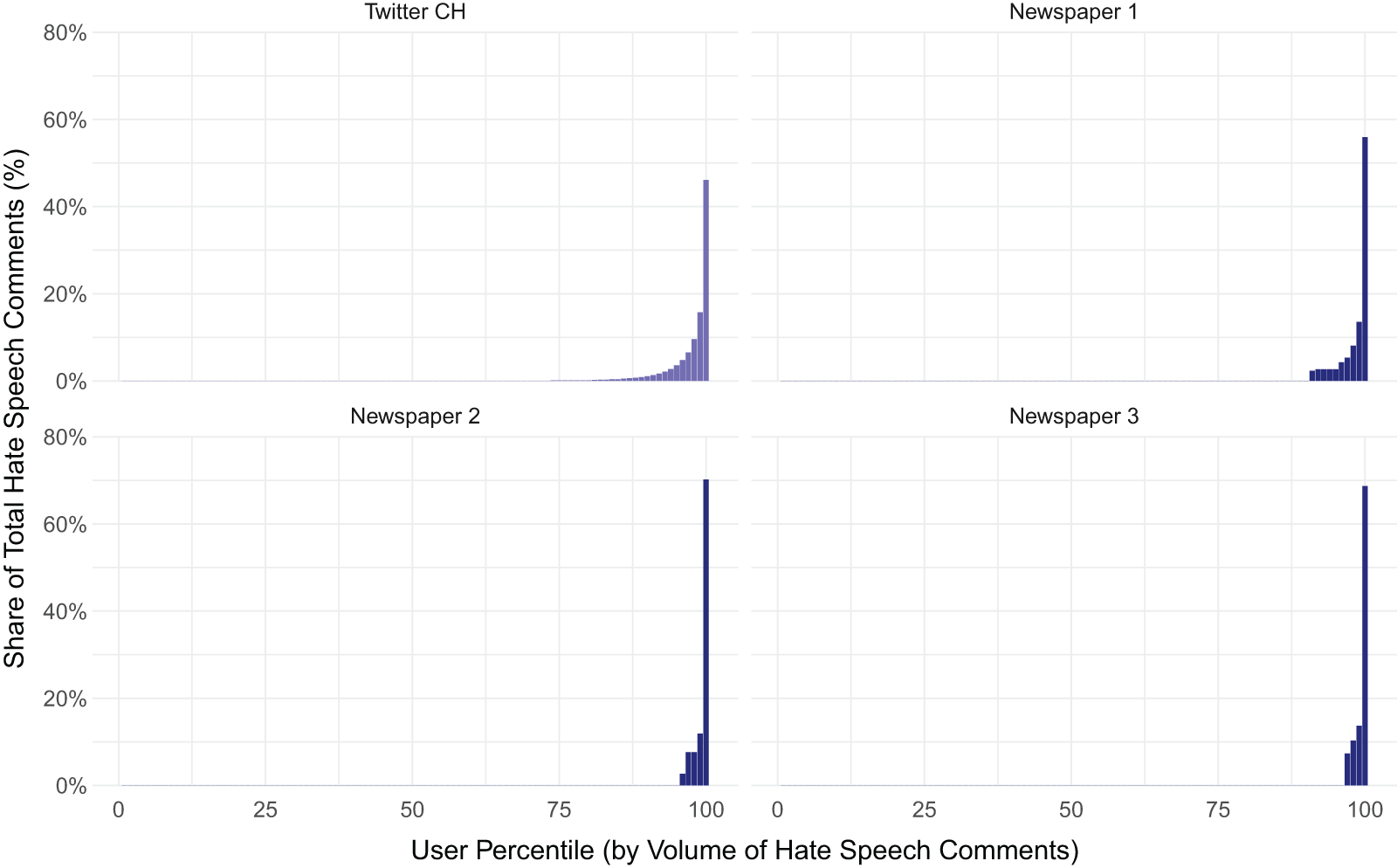
The researchers ran a field experiment on Twitter (now X) in 2021-22, replying to hateful tweets with specially created sock-puppet accounts that employed different counterspeech strategies. They found that counterspeech worked in reducing users’ propensity of writing hate tweets in the future – but only for relatively less hateful users, those who posted hate less often before the experiment. For those users who had been more hateful before the experimentusers, counterspeech was ineffective.
These findings indicate that the patterns of hate speech production matter greatly for how to combat it. In particular, they suggest that content moderation efforts may be most effective on users who only occasionally post hate, while the most hateful users – who produce almost all the hate posted online – are largely resistant, at least to the kinds of bystander social pressure tested in this experiment. Instead, persistently hateful users may require more targeted interventions.
Study reference: Gennaro, Gloria et al. (2025). The distribution of hate speech and its implications for content moderation. Political Science Research and Methods.